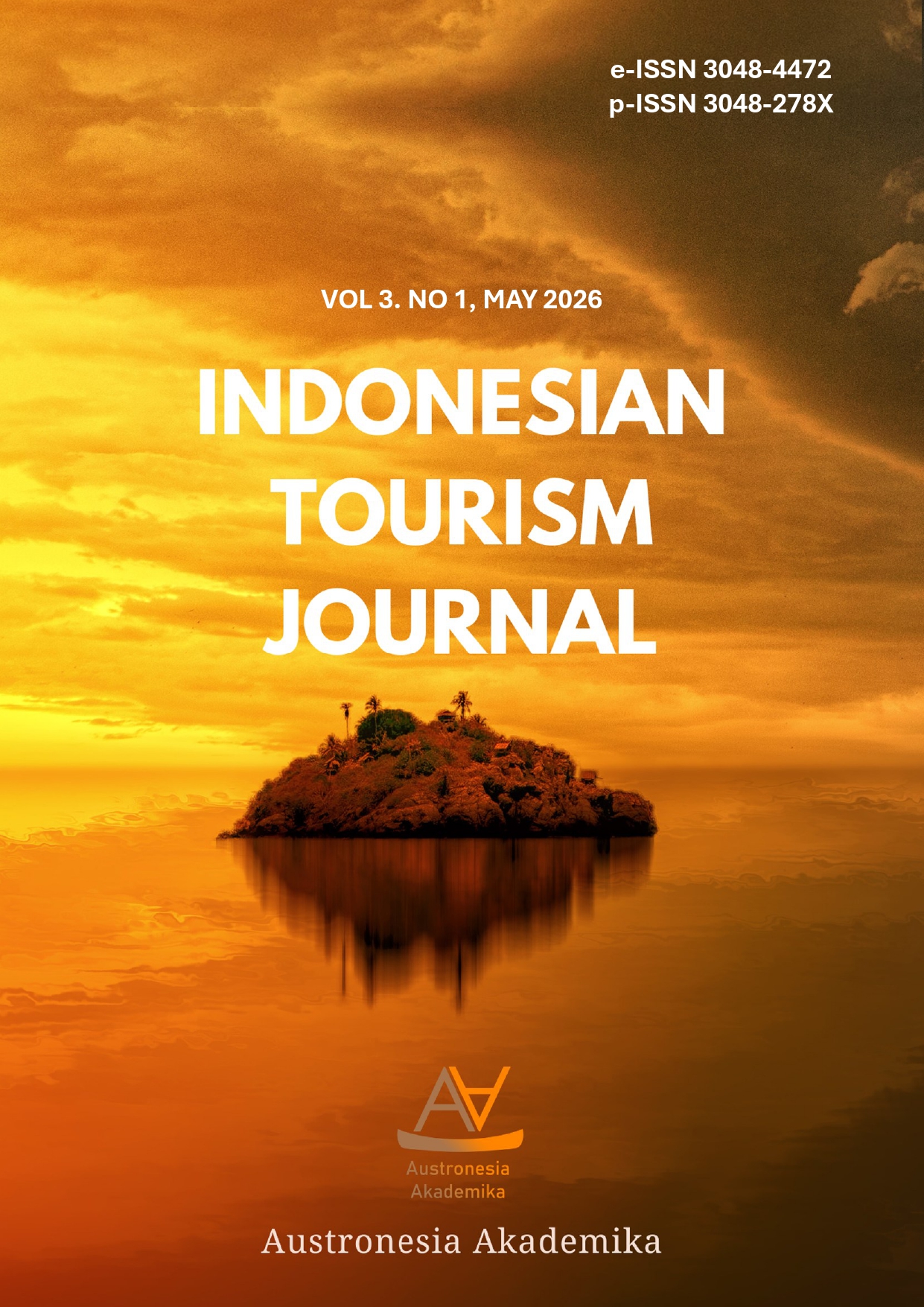
Evaluation on the Accuracy of Artificial Intelligence (AI) Assisted Revenue Management Forecasting: Evidence from a Luxury Resort in Bali
DOI:
https://doi.org/10.69812/itj.v3i1.259Keywords:
Evaluation, Artificial Intelligence, Revenue Management, ForecastingAbstract
This study examines the accuracy of artificial intelligence-assisted forecasting in supporting hotel revenue management at Amarterra Villas Resort Bali Nusa Dua, a five-star luxury resort operating within Bali’s premium leisure tourism market. The research was motivated by the growing need for hotels to improve forecasting reliability amid fluctuating demand, dynamic pricing conditions, and limited dedicated revenue management manpower. A descriptive quantitative research design with comparative forecasting accuracy analysis was applied using secondary operational data consisting of AI-generated forecasts and actual hotel performance records for Room Nights, Average Daily Rate (ADR), and Revenue. Forecasting accuracy was evaluated using Mean Absolute Error (MAE), Root Mean Squared Error (RMSE), Mean Absolute Percentage Error (MAPE), Mean Forecast Error (MFE), annual bias percentage, paired sample t-tests, and Pearson correlation analysis. The findings show that AI-assisted forecasting performed more accurately in predicting Room Nights than ADR and Revenue. Room Nights recorded relatively low forecast errors, with an MAE of 3.69, RMSE of 4.61, and MAPE of 11.65%, and the paired sample t-test indicated no statistically significant difference between forecasted and actual demand. In contrast, ADR and Revenue showed higher error values and statistically significant differences, indicating systematic underestimation in pricing and financial performance. Pearson correlation results further suggest that AI forecasts were useful in tracking general trends, although they remained less precise in predicting exact monetary outcomes.
Downloads
References
Abrate, G., Nicolau, J. L., & Viglia, G. (2019). The impact of dynamic price variability on revenue maximization. Tourism Management, 74, 224–233. https://doi.org/10.1016/j.tourman.2019.03.013
Altin, M. (2017). A taxonomy of hotel revenue management implementation strategies. Journal of Revenue and Pricing Management, 16(3), 246–264. https://doi.org/10.1057/s41272-017-0077-1
Anderson, C. K., & Xie, X. (2010). Improving hospitality industry sales: Twenty-five years of revenue management. Cornell Hospitality Quarterly, 51(1), 53–67. https://doi.org/10.1177/1938965509354697
Anderson, C. K., & Xie, X. (2016). Dynamic pricing in hospitality: Overview and opportunities. International Journal of Revenue Management, 9(2/3), 165–174.
Bryman, A. (2016). Social research methods (5th ed.). Oxford University Press.
Bulchand-Gidumal, J., William Secin, E., O’Connor, P., & Buhalis, D. (2024). Artificial intelligence’s impact on hospitality and tourism marketing: Exploring key themes and addressing challenges. Current Issues in Tourism, 27(14), 2345–2362. https://doi.org/10.1080/13683500.2023.2229480
Cai, Y., Xie, K. L., & Law, R. (2024). Intellectual landscape and emerging trends of big data analytics in hospitality and tourism research. International Journal of Hospitality Management, 116, 103620. https://doi.org/10.1016/j.ijhm.2023.103620
Creswell, J. W., & Creswell, J. D. (2018). Research design: Qualitative, quantitative, and mixed methods approaches (5th ed.). SAGE Publications.
Guizzardi, A., Ballestra, L. V., & Ranieri, E. (2022). Hotel dynamic pricing, stochastic demand and COVID-19. Annals of Tourism Research, 97, 103495. https://doi.org/10.1016/j.annals.2022.103495
Hair, J. F., Black, W. C., Babin, B. J., & Anderson, R. E. (2019). Multivariate data analysis (8th ed.). Cengage Learning.
Henriques, H., & Pereira, L. N. (2024). Hotel demand forecasting models and methods using artificial intelligence: A systematic literature review. Tourism & Management Studies, 20(3), 39–51. https://doi.org/10.18089/tms.20240304
Huang, L., & Zheng, W. (2021). Novel deep learning approach for forecasting daily hotel demand with agglomeration effect. International Journal of Hospitality Management, 98, 103038. https://doi.org/10.1016/j.ijhm.2021.103038
Ivanov, S., Del Chiappa, G., & Hayes, A. (2021). The research-practice gap in hotel revenue management: Insights from Italy. International Journal of Hospitality Management, 95, 102924. https://doi.org/10.1016/j.ijhm.2021.102924
Kaya, K., Medeni, I. T., Medeni, T. D., & Sağsan, M. (2022). Demand forecasting model using hotel clustering findings for hospitality industry. Information Processing & Management, 59(2), 102816. https://doi.org/10.1016/j.ipm.2021.102816
Kimes, S. E. (2011). The future of hotel revenue management. Journal of Revenue and Pricing Management, 10(1), 62–72. https://doi.org/10.1057/rpm.2010.47
Kimes, S. E., & Thompson, G. M. (2005). An evaluation of heuristic methods for determining the best table mix in full-service restaurants. Journal of Operations Management, 23(6), 599–617. https://doi.org/10.1016/j.jom.2004.07.010
Kimes, S. E., & Wirtz, J. (2003). Has revenue management become acceptable? Findings from an international study on the perceived fairness of rate fences. Journal of Service Research, 6(2), 125–135. https://doi.org/10.1177/1094670503257038
Koupriouchina, L., van der Rest, J.-P. I., & Schwartz, Z. (2014). On revenue management and the use of occupancy forecasting error measures. International Journal of Hospitality Management, 41, 104–114. https://doi.org/10.1016/j.ijhm.2014.05.002
Kumawat, E., Farooq, R., & Khalid, F. (2025). Artificial intelligence through the lens of hospitality employees: A systematic literature review. International Journal of Hospitality Management, 126, 104036. https://doi.org/10.1016/j.ijhm.2024.104036
Lee, M. (2018). Modeling and forecasting hotel room demand based on advance booking information. Tourism Management, 66, 62–71. https://doi.org/10.1016/j.tourman.2017.11.004
Makridakis, S., Spiliotis, E., & Assimakopoulos, V. (2020). The M4 competition: 100,000 time series and 61 forecasting methods. International Journal of Forecasting, 36(1), 54–74. https://doi.org/10.1016/j.ijforecast.2019.04.014
Millauer, T., & Vellekoop, M. (2019). Artificial intelligence in today’s hotel revenue management: Opportunities and risks. Research in Hospitality Management, 9(2), 121–124. https://doi.org/10.1080/22243534.2019.1689702
Mitra, S. K. (2020). An analysis of asymmetry in dynamic pricing of hospitality industry. International Journal of Hospitality Management, 89, 102406. https://doi.org/10.1016/j.ijhm.2019.102406
Nair, G. K. (2019). Dynamics of pricing and non-pricing strategies, revenue management performance and competitive advantage in hotel industry. International Journal of Hospitality Management, 82, 287–297. https://doi.org/10.1016/j.ijhm.2018.10.007
Noone, B. M., & McGuire, K. A. (2014). Pricing in a social world: The influence of non-price information on hotel choice. Journal of Revenue and Pricing Management, 13(5), 385–401. https://doi.org/10.1057/rpm.2014.13
Pereira, L. N. (2016). An introduction to helpful forecasting methods for hotel revenue management. International Journal of Hospitality Management, 58, 13–23. https://doi.org/10.1016/j.ijhm.2016.07.003
Pereira, L. N., & Cerqueira, V. (2022). Forecasting hotel demand for revenue management using machine learning regression methods. Current Issues in Tourism, 25(17), 2733–2750. https://doi.org/10.1080/13683500.2021.1999397
Rodríguez-Algeciras, A., & Talón-Ballestero, P. (2017). An empirical analysis of the effectiveness of hotel revenue management in five-star hotels in Barcelona, Spain. Journal of Hospitality and Tourism Management, 32, 24–34. https://doi.org/10.1016/j.jhtm.2017.04.004
Sanjiwani, A. T., Pitanatri, P. D. S., & Loanata, C. P. (2025). Big data analytics to understand guest sentiment: Time series study of TripAdvisor reviews for luxury hotel in Bali. Journal of Indigenous Culture, Tourism, and Language, 1(1), 61–73. https://doi.org/10.35912/jictl.v1i1.3256
Saunders, M. N. K., Lewis, P., & Thornhill, A. (2019). Research methods for business students (8th ed.). Pearson.
Selmi, N., Dornier, R., & Guérin, A. M. (2018). A measure of revenue management orientation and its mediating role in the relationship between market orientation and performance. Journal of Business Research, 89, 99–109. https://doi.org/10.1016/j.jbusres.2018.04.007
Song, H., & Li, G. (2008). Tourism demand modelling and forecasting: A review of recent research. Tourism Management, 29(2), 203–220. https://doi.org/10.1016/j.tourman.2007.07.016
Song, H., & Turner, L. (2006). Tourism demand forecasting. In L. Dwyer & P. Forsyth (Eds.), International handbook on the economics of tourism (pp. 89–114). Edward Elgar Publishing.
Song, H., Witt, S. F., & Li, G. (2009). The advanced econometrics of tourism demand. Routledge.
Talluri, K. T., & Van Ryzin, G. J. (2004). The theory and practice of revenue management. Springer.
Tussyadiah, I. (2020). A review of research into automation in tourism: Launching the Annals of Tourism Research Curated Collection on Artificial Intelligence and Robotics in Tourism. Annals of Tourism Research, 81, 102883. https://doi.org/10.1016/j.annals.2020.102883
Viglia, G., & Abrate, G. (2019). Revenue and yield management: A perspective article. Tourism Review, 75(1), 294–298. https://doi.org/10.1108/TR-04-2019-0117
Viverit, L., Heo, C. Y., Pereira, L. N., & Tiana, G. (2023). Application of machine learning to cluster hotel booking curves for hotel demand forecasting. International Journal of Hospitality Management, 111, 103455. https://doi.org/10.1016/j.ijhm.2023.103455
Weatherford, L. R., & Kimes, S. E. (2003). A comparison of forecasting methods for hotel revenue management. International Journal of Forecasting, 19(3), 401–415. https://doi.org/10.1016/S0169-2070(02)00011-0
Webb, T., Schwartz, Z., Xiang, Z., & Altin, M. (2020). Revenue management forecasting: The resiliency of advanced booking methods given dynamic booking windows. International Journal of Hospitality Management, 89, 102590. https://doi.org/10.1016/j.ijhm.2020.102590
Webb, T., Schwartz, Z., Xiang, Z., & Altin, M. (2022). Hotel revenue management forecasting accuracy: The hidden impact of booking windows. Journal of Hospitality and Tourism Insights, 5(5), 950–968. https://doi.org/10.1108/JHTI-05-2021-0124
Xu, J., Zhang, W., Li, H., Zheng, X., & Zhang, J. (2024). User-generated photos in hotel demand forecasting. Annals of Tourism Research, 108, 103820. https://doi.org/10.1016/j.annals.2024.103820
Zahidi, F., Kaluvilla, B. B., & Mulla, T. (2024). Embracing the new era: Artificial intelligence and its multifaceted impact on the hospitality industry. Journal of Open Innovation: Technology, Market, and Complexity, 10(4), 100390. https://doi.org/10.1016/j.joitmc.2024.100390
Zhang, D., & Niu, W. (2024). Leveraging online reviews for hotel demand forecasting: A deep learning approach. Information Processing & Management, 61(2), 103527. https://doi.org/10.1016/j.ipm.2023.103527
Zheng, W., Huang, L., Li, C., & Law, R. (2024). Hotel demand forecasting with multi-scale spatiotemporal features. International Journal of Hospitality Management, 123, 103916. https://doi.org/10.1016/j.ijhm.2024.103916
Downloads
Published
Issue
Section
License
Copyright (c) 2026 Axell Pratama Kartika, Putu Diah Sastri Pitanatri, Ni Made Suastini

This work is licensed under a Creative Commons Attribution-ShareAlike 4.0 International License.
You are free to:
- Share — copy and redistribute the material in any medium or format for any purpose, even commercially.
- Adapt — remix, transform, and build upon the material for any purpose, even commercially.
- The licensor cannot revoke these freedoms as long as you follow the license terms.
Under the following terms:
- Attribution — You must give appropriate credit, provide a link to the license, and indicate if changes were made . You may do so in any reasonable manner, but not in any way that suggests the licensor endorses you or your use.
- ShareAlike — If you remix, transform, or build upon the material, you must distribute your contributions under the same license as the original.
- No additional restrictions — You may not apply legal terms or technological measures that legally restrict others from doing anything the license permits.