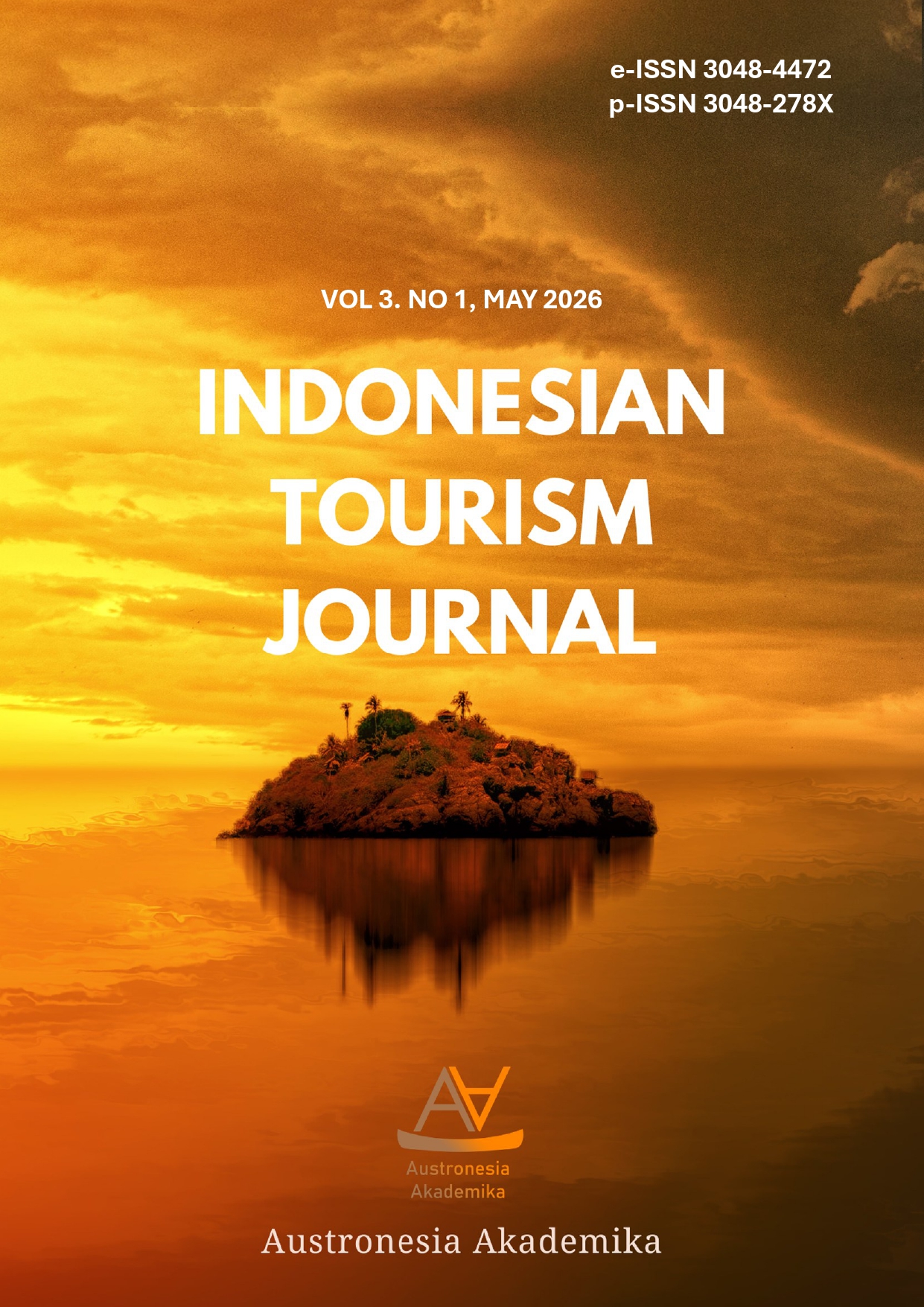
The Depreciation of the Rupiah and the Increase in Tourist Arrivals: A PESTEL Analysis of Indonesia’s Tourism Competitiveness
DOI:
https://doi.org/10.69812/itj.v3i1.263Keywords:
Rupiah Depreciation, PESTEL Analysis, Tourism Competitiveness, Indonesia TourismAbstract
This study examines the relationship between the depreciation of the Indonesian rupiah and the increase in international tourist arrivals through a PESTEL analysis of Indonesia’s tourism competitiveness. The issue is important because currency depreciation may improve destination affordability for foreign tourists, yet its contribution to competitiveness depends on broader political, economic, social, technological, environmental, and legal conditions. Using a qualitative descriptive design, this article relies entirely on secondary data, including exchange rate information, tourism statistics, government documents, institutional reports, and scholarly literature. The analysis shows that rupiah depreciation can strengthen Indonesia’s price competitiveness by increasing foreign tourists’ purchasing power and making tourism services relatively cheaper. However, this advantage is conditional because tourism businesses may also face higher operational costs, especially when they depend on imported inputs, foreign-denominated expenses, and international digital platforms. The findings further indicate that tourist arrivals are shaped by digital visibility, online reviews, destination image, policy coordination, community readiness, environmental carrying capacity, and regulatory certainty. Therefore, rupiah depreciation should not be treated as an independent driver of tourism growth, but as a temporary opportunity that must be supported by integrated destination governance, sustainable management, digital promotion, and local economic participation. The study concludes that Indonesia’s tourism competitiveness will improve only if short-term affordability is transformed into long-term, inclusive, and sustainable destination value for future national tourism development.
Downloads
References
Aguilar, F. J. (1967). Scanning the business environment. Macmillan.
Andereck, K. L., Valentine, K. M., Knopf, R. C., & Vogt, C. A. (2005). Residents’ perceptions of community tourism impacts. Annals of Tourism Research, 32(4), 1056–1076. https://doi.org/10.1016/j.annals.2005.03.001
Appiah, M. K., Sedegah, D. D., & Akolaa, R. A. (2021). The implications of macroenvironmental forces and SMEs investment behaviour in the energy sector: The role of supply chain resilience. Heliyon, 7(11), e08426. https://doi.org/10.1016/j.heliyon.2021.e08426
Armutcu, B., Tan, A., Amponsah, M., Parida, S., & Ramkissoon, H. (2023). Tourist behaviour: The role of digital marketing and social media. Acta Psychologica, 240, 104025. https://doi.org/10.1016/j.actpsy.2023.104025
Ayeh, J. K., Au, N., & Law, R. (2013). Do we believe in TripAdvisor? Examining credibility perceptions and online travelers’ attitude toward using user-generated content. Journal of Travel Research, 52(4), 437–452. https://doi.org/10.1177/0047287512475217
Badan Pusat Statistik. (2026). Statistics of international tourist arrivals in Indonesia. BPS-Statistics Indonesia.
Bank Indonesia. (2026). Bank Indonesia foreign exchange transaction rates. Bank Indonesia.
Barkauskas, V., Barkauskienė, K., & Jasinskas, E. (2015). Analysis of macro environmental factors influencing the development of rural tourism: Lithuanian case. Procedia - Social and Behavioral Sciences, 213, 167–172. https://doi.org/10.1016/j.sbspro.2015.11.421
Bowen, G. A. (2009). Document analysis as a qualitative research method. Qualitative Research Journal, 9(2), 27–40. https://doi.org/10.3316/QRJ0902027
Bramwell, B., & Sharman, A. (1999). Collaboration in local tourism policymaking. Annals of Tourism Research, 26(2), 392–415. https://doi.org/10.1016/S0160-7383(98)00105-4
Buckley, R. (2012). Sustainable tourism: Research and reality. Annals of Tourism Research, 39(2), 528–546. https://doi.org/10.1016/j.annals.2012.02.003
Budeanu, A., Miller, G., Moscardo, G., & Ooi, C. S. (2016). Sustainable tourism, progress, challenges and opportunities: An introduction. Journal of Cleaner Production, 111, 285–294. https://doi.org/10.1016/j.jclepro.2015.10.027
Buhalis, D., & Law, R. (2008). Progress in information technology and tourism management: 20 years on and 10 years after the Internet—The state of eTourism research. Tourism Management, 29(4), 609–623. https://doi.org/10.1016/j.tourman.2008.01.005
Corgel, J. B., Lane, J., & Walls, A. (2013). How currency exchange rates affect the demand for U.S. hotel rooms. International Journal of Hospitality Management, 35, 78–88. https://doi.org/10.1016/j.ijhm.2013.05.002
Creswell, J. W., & Creswell, J. D. (2018). Research design: Qualitative, quantitative, and mixed methods approaches (5th ed.). SAGE Publications.
Croes, R., & Vanegas, M. (2005). An econometric study of tourist arrivals in Aruba and its implications. Tourism Management, 26(6), 879–890. https://doi.org/10.1016/j.tourman.2004.04.007
Cronjé, D. F., & du Plessis, E. (2020). A review on tourism destination competitiveness. Journal of Hospitality and Tourism Management, 45, 256–265. https://doi.org/10.1016/j.jhtm.2020.06.012
Crouch, G. I., & Ritchie, J. R. B. (1999). Tourism, competitiveness, and societal prosperity. Journal of Business Research, 44(3), 137–152. https://doi.org/10.1016/S0148-2963(97)00196-3
Cucculelli, M., & Goffi, G. (2016). Does sustainability enhance tourism destination competitiveness? Evidence from Italian destinations of excellence. Journal of Cleaner Production, 111, 370–382. https://doi.org/10.1016/j.jclepro.2014.12.069
De Vita, G. (2014). The long-run impact of exchange rate regimes on international tourism flows. Tourism Management, 45, 226–233. https://doi.org/10.1016/j.tourman.2014.05.001
Ding, D., & Timmer, Y. (2023). Exchange rate elasticities of international tourism and the role of dominant currency pricing. Journal of International Money and Finance, 137, 102908. https://doi.org/10.1016/j.jimonfin.2023.102908
Dogru, T., Sirakaya-Turk, E., & Crouch, G. I. (2017). Remodeling international tourism demand: Old theory and new evidence. Tourism Management, 60, 47–55. https://doi.org/10.1016/j.tourman.2016.11.010
Dwyer, L., Edwards, D., Mistilis, N., Roman, C., & Scott, N. (2009). Destination and enterprise management for a tourism future. Tourism Management, 30(1), 63–74. https://doi.org/10.1016/j.tourman.2008.04.002
Dwyer, L., Forsyth, P., & Rao, P. (2000). The price competitiveness of travel and tourism: A comparison of 19 destinations. Tourism Management, 21(1), 9–22. https://doi.org/10.1016/S0261-5177(99)00081-3
Enright, M. J., & Newton, J. (2004). Tourism destination competitiveness: A quantitative approach. Tourism Management, 25(6), 777–788. https://doi.org/10.1016/j.tourman.2004.06.008
Goffi, G., Cucculelli, M., & Masiero, L. (2019). Fostering tourism destination competitiveness in developing countries: The role of sustainability. Journal of Cleaner Production, 209, 101–115. https://doi.org/10.1016/j.jclepro.2018.10.208
Gössling, S., Scott, D., Hall, C. M., Ceron, J. P., & Dubois, G. (2012). Consumer behaviour and demand response of tourists to climate change. Annals of Tourism Research, 39(1), 36–58. https://doi.org/10.1016/j.annals.2011.11.002
Gretzel, U., Sigala, M., Xiang, Z., & Koo, C. (2015). Smart tourism: Foundations and developments. Electronic Markets, 25(3), 179–188. https://doi.org/10.1007/s12525-015-0196-8
Han, Z., Durbarry, R., & Sinclair, M. T. (2006). Modelling US tourism demand for European destinations. Tourism Management, 27(1), 1–10. https://doi.org/10.1016/j.tourman.2004.06.015
Hays, S., Page, S. J., & Buhalis, D. (2013). Social media as a destination marketing tool: Its use by national tourism organisations. Current Issues in Tourism, 16(3), 211–239. https://doi.org/10.1080/13683500.2012.662215
Higgins-Desbiolles, F. (2018). Sustainable tourism: Sustaining tourism or something more? Tourism Management Perspectives, 25, 157–160. https://doi.org/10.1016/j.tmp.2017.11.017
Ho, P. T., Ho, M. T., & Huang, M. L. (2024). Understanding the impact of tourist behavior change on travel agencies in developing countries: Strategies for enhancing the tourist experience. Acta Psychologica, 249, 104463. https://doi.org/10.1016/j.actpsy.2024.104463
Irandoust, M. (2019). On the relation between exchange rates and tourism demand: A nonlinear and asymmetric analysis. The Journal of Economic Asymmetries, 20, e00123. https://doi.org/10.1016/j.jeca.2019.e00123
Kim, J., & Lee, C. K. (2017). Role of tourism price in attracting international tourists: The case of Japanese inbound tourism from South Korea. Journal of Destination Marketing & Management, 6(1), 76–83. https://doi.org/10.1016/j.jdmm.2016.03.002
Koens, K., Postma, A., & Papp, B. (2018). Is overtourism overused? Understanding the impact of tourism in a city context. Sustainability, 10(12), 4384. https://doi.org/10.3390/su10124384
Kovačević, N. D., Kovačević, L., Stankov, U., Dragićević, V., & Miletić, A. (2018). Applying destination competitiveness model to strategic tourism development of small destinations: The case of South Banat district. Journal of Destination Marketing & Management, 8, 114–124. https://doi.org/10.1016/j.jdmm.2017.01.002
Kumar, S., Kumar, V., Bhatt, I. K., Kumar, S., & Attri, K. (2024). Digital transformation in tourism sector: Trends and future perspectives from a bibliometric-content analysis. Journal of Hospitality and Tourism Insights, 7(3), 1553–1576. https://doi.org/10.1108/JHTI-10-2022-0472
Leung, D., Law, R., Van Hoof, H., & Buhalis, D. (2013). Social media in tourism and hospitality: A literature review. Journal of Travel & Tourism Marketing, 30(1–2), 3–22. https://doi.org/10.1080/10548408.2013.750919
Lim, C. (1997). Review of international tourism demand models. Annals of Tourism Research, 24(4), 835–849. https://doi.org/10.1016/S0160-7383(97)00049-2
Martins, L. F., Gan, Y., & Ferreira-Lopes, A. (2017). An empirical analysis of the influence of macroeconomic determinants on world tourism demand. Tourism Management, 61, 248–260. https://doi.org/10.1016/j.tourman.2017.01.008
Miller, G. (2001). The development of indicators for sustainable tourism: Results of a Delphi survey of tourism researchers. Tourism Management, 22(4), 351–362. https://doi.org/10.1016/S0261-5177(00)00067-4
Mohan, P. (2022). Sustainable tourism and the sustainable development goals in sub-national island jurisdictions: The case of Tobago. Island Studies Journal, 17(2), 168–191. https://doi.org/10.24043/isj.183
Nunkoo, R., & Ramkissoon, H. (2012). Power, trust, social exchange and community support. Annals of Tourism Research, 39(2), 997–1023. https://doi.org/10.1016/j.annals.2011.11.017
Pan, B., & Fesenmaier, D. R. (2006). Online information search: Vacation planning process. Annals of Tourism Research, 33(3), 809–832. https://doi.org/10.1016/j.annals.2006.03.006
Papatheodorou, A. (1999). The demand for international tourism in the Mediterranean region. Applied Economics, 31(5), 619–630. https://doi.org/10.1080/000368499324066
Patsouratis, V., Frangouli, Z., & Anastasopoulos, G. (2005). Competition in tourism among the Mediterranean countries. Applied Economics, 37(16), 1865–1870. https://doi.org/10.1080/00036840500217226
Peng, B., Song, H., Crouch, G. I., & Witt, S. F. (2015). A meta-analysis of international tourism demand elasticities. Journal of Travel Research, 54(5), 611–633. https://doi.org/10.1177/0047287514528283
Perles-Ribes, J. F., Ramón-Rodríguez, A. B., Moreno-Izquierdo, L., & Torregrosa Martí, M. T. (2016). Economic crisis and tourism competitiveness in Spain: Permanent effects or transitory shocks? Current Issues in Tourism, 19(12), 1210–1234. https://doi.org/10.1080/13683500.2013.849666
Saarinen, J. (2006). Traditions of sustainability in tourism studies. Annals of Tourism Research, 33(4), 1121–1140. https://doi.org/10.1016/j.annals.2006.06.007
Snyder, H. (2019). Literature review as a research methodology: An overview and guidelines. Journal of Business Research, 104, 333–339. https://doi.org/10.1016/j.jbusres.2019.07.039
Song, H., & Li, G. (2008). Tourism demand modelling and forecasting: A review of recent research. Tourism Management, 29(2), 203–220. https://doi.org/10.1016/j.tourman.2007.07.016
Sparks, B. A., & Browning, V. (2011). The impact of online reviews on hotel booking intentions and perception of trust. Tourism Management, 32(6), 1310–1323. https://doi.org/10.1016/j.tourman.2010.12.011
Tribe, J. (2023). The economics of recreation, leisure and tourism (6th ed.). Routledge.
Xiang, Z., Magnini, V. P., & Fesenmaier, D. R. (2015). Information technology and consumer behavior in travel and tourism: Insights from travel planning using the Internet. Journal of Retailing and Consumer Services, 22, 244–249. https://doi.org/10.1016/j.jretconser.2014.08.005
Yin, R. K. (2018). Case study research and applications: Design and methods (6th ed.). SAGE Publications.
Yuan, Y., Chan, C. S., Eichelberger, S., Ma, H., & Pikkemaat, B. (2022). The effect of social media on travel planning process by Chinese tourists: The way forward to tourism futures. Journal of Tourism Futures. https://doi.org/10.1108/JTF-04-2021-0094
Zahari, A. R., & Romli, F. I. (2019). Analysis of suborbital flight operation using PESTLE. Journal of Atmospheric and Solar-Terrestrial Physics, 192, 104901. https://doi.org/10.1016/j.jastp.2018.08.006
Zhang, J. (2025). Patterns of innovation-driven tourism competitiveness. Tourism Management, 106, 105011. https://doi.org/10.1016/j.tourman.2024.105011
Downloads
Published
Issue
Section
License
Copyright (c) 2026 Mahadiansar Mahadiansar, Agus Rio, Yudithia Yudithia, Ilham Sentosa

This work is licensed under a Creative Commons Attribution-ShareAlike 4.0 International License.
You are free to:
- Share — copy and redistribute the material in any medium or format for any purpose, even commercially.
- Adapt — remix, transform, and build upon the material for any purpose, even commercially.
- The licensor cannot revoke these freedoms as long as you follow the license terms.
Under the following terms:
- Attribution — You must give appropriate credit, provide a link to the license, and indicate if changes were made . You may do so in any reasonable manner, but not in any way that suggests the licensor endorses you or your use.
- ShareAlike — If you remix, transform, or build upon the material, you must distribute your contributions under the same license as the original.
- No additional restrictions — You may not apply legal terms or technological measures that legally restrict others from doing anything the license permits.