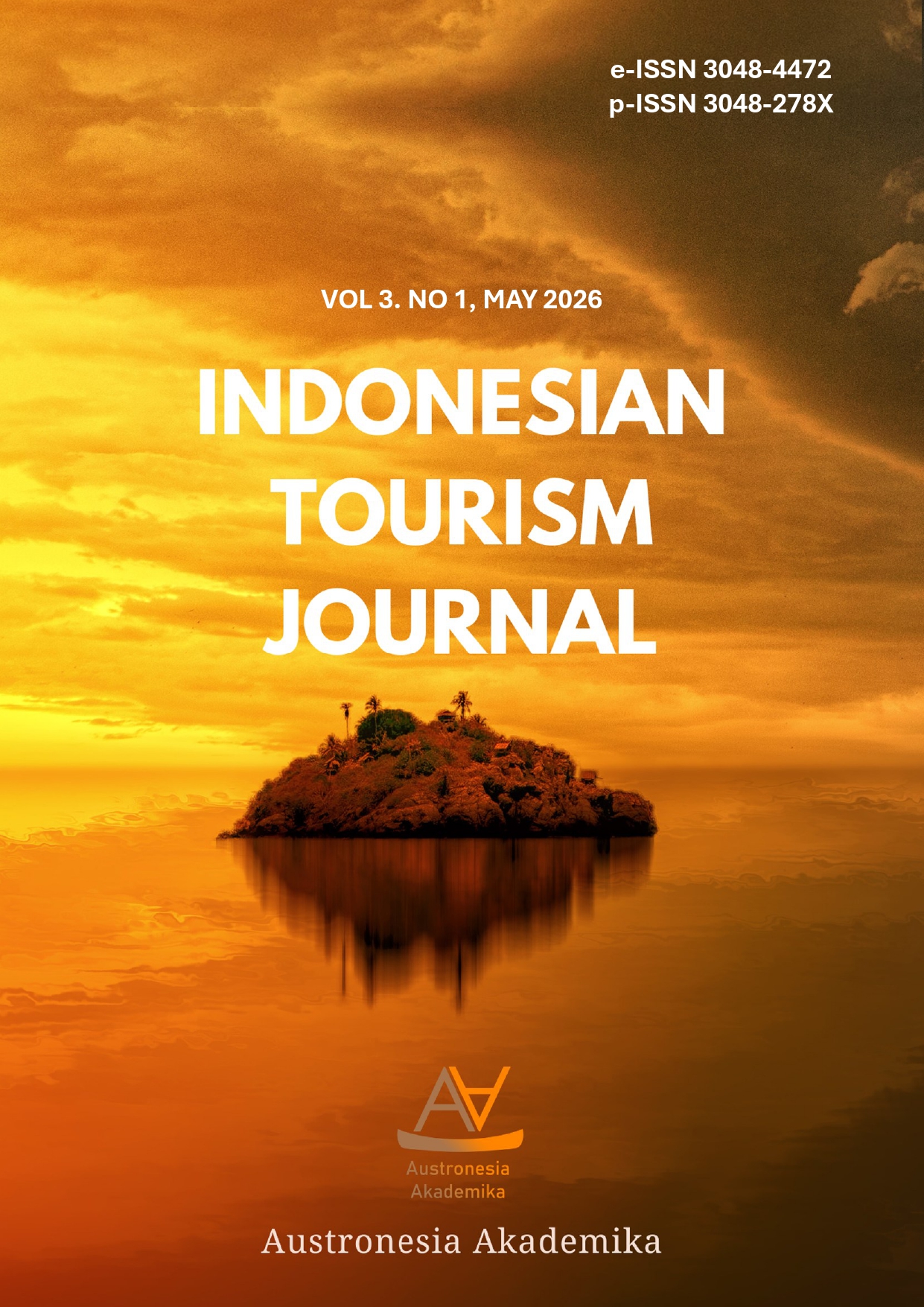
Persuasive Communication in Indonesian Digital Tourism Promotion: Destination Branding, Local Identity, and Tourist Engagement
DOI:
https://doi.org/10.69812/itj.v3i1.262Keywords:
Persuasive Communication, Digital Tourism Advertisements, Destination Branding, Local IdentityAbstract
Digital tourism promotion has transformed the way destinations are communicated, imagined, and selected by potential tourists. In Indonesia, tourism advertisements found through Google search results and Google Images widely use persuasive language and visual design to attract audiences, promote travel packages, and construct destination images. This study aims to examine how persuasive communication is used in Indonesian digital tourism advertisements, how verbal and visual elements construct destination branding, and how these advertisements represent local identity, tourist segmentation, and multimodal tourism promotion. This research employed a qualitative design with descriptive digital content analysis. The data consisted of 30 digital tourism advertisements in the form of posters, flyers, and online tourism brochures promoting Indonesian destinations. The data were selected through purposive sampling based on destination relevance, persuasive text, visual clarity, promotional content, and public accessibility through Google search results. The findings show that persuasive language is constructed through direct invitations, price emphasis, promotional claims, service assurance, and experiential expressions such as “Book Now,” “Promo,” “Start From,” “Paket Murah,” and “Liburan Yuk.” Visual elements such as beaches, mountains, temples, lakes, islands, cultural icons, and tourism activities strengthen destination branding and shape tourist imagination. The findings also reveal that local identity and tourist segmentation are represented through halal trip, honeymoon, study tour, open trip, private tour, family trip, and budget tourism packages. This study concludes that Indonesian digital tourism advertisements function as multimodal promotional texts that integrate language, image, price, facilities, itinerary, and booking information to strengthen destination branding.
Downloads
References
Abdillah, F., Afiff, A. Z., Hati, S. R. H., & Furinto, A. (2022). A local destination story for the restoration of the destination image affected by Covid-19 crisis: Evidence from Indonesia. Heliyon, 8(6), e09784. https://doi.org/10.1016/j.heliyon.2022.e09784
Armutcu, B., Tan, A., Amponsah, M., Parida, S., & Ramkissoon, H. (2023). Tourist behaviour: The role of digital marketing and social media. Acta Psychologica, 240, 104025. https://doi.org/10.1016/j.actpsy.2023.104025
Blanco-Moreno, S., González-Fernández, A. M., Muñoz, P., & Casaló, L. V. (2024). Understanding engagement with Instagram posts about tourism destinations. Journal of Destination Marketing & Management, 34, 100948. https://doi.org/10.1016/j.jdmm.2024.100948
Buhalis, D., & Law, R. (2008). Progress in information technology and tourism management: 20 years on and 10 years after the internet—The state of eTourism research. Tourism Management, 29(4), 609–623. https://doi.org/10.1016/j.tourman.2008.01.005
Can, A. S., Barreda, A. A., Nusair, K., & Cobanoglu, C. (2025). Examining the impact of joint brand advertising on tourists’ behavioural responses. International Journal of Advertising. https://doi.org/10.1080/02650487.2024.2432237
Dann, G. M. S. (1996). The language of tourism: A sociolinguistic perspective. CAB International.
Duarte, A., & Soeiro, R. (2025). Destinations, experiences, and places: The role of storytelling in tourism advertising. Janus.net, E-Journal of International Relations, 15(2), 94–113. https://doi.org/10.26619/1647-7251.DT0125.5
Echtner, C. M., & Ritchie, J. R. B. (1991). The meaning and measurement of destination image. Journal of Tourism Studies, 2(2), 2–12.
Garay, L. (2019). #Visitspain. Breaking down affective and cognitive attributes in the social media construction of the tourist destination image. Tourism Management Perspectives, 32, 100560. https://doi.org/10.1016/j.tmp.2019.100560
Grosso, F. O., Rodríguez-Molina, M. Á., & Castañeda-García, J. A. (2024). The impact of destination-brand social media content on consumer online brand-related activities (COBRAs). Tourism Management Perspectives, 51, 101239. https://doi.org/10.1016/j.tmp.2024.101239
Guo, Y., Yu, M., & Zhao, Y. (2024). Impact of destination advertising on tourists’ visit intention: The influence of self-congruence, self-confidence, and destination reputation. Journal of Destination Marketing & Management, 31, 100852. https://doi.org/10.1016/j.jdmm.2023.100852
Hays, S., Page, S. J., & Buhalis, D. (2013). Social media as a destination marketing tool: Its use by national tourism organisations. Current Issues in Tourism, 16(3), 211–239. https://doi.org/10.1080/13683500.2012.662215
Huerta-Álvarez, R., Cambra-Fierro, J. J., & Fuentes-Blasco, M. (2020). The interplay between social media communication, brand equity and brand engagement in tourist destinations: An analysis in an emerging economy. Journal of Destination Marketing & Management, 16, 100413. https://doi.org/10.1016/j.jdmm.2020.100413
Jiménez-Barreto, J., Rubio, N., & Campo, S. (2020). Destination brand authenticity: What an experiential simulacrum! A multigroup analysis of its antecedents and outcomes through official online platforms. Tourism Management, 77, 104022. https://doi.org/10.1016/j.tourman.2019.104022
Jokom, R., Wijaya, S., Kristanti, M., & Widjaja, D. C. (2025). Sustainable tourism experiences: The role of digital technology and government support in creating tourists’ memorable experiences. Cogent Social Sciences, 11(1), 2482026. https://doi.org/10.1080/23311975.2025.2482026
Kavaratzis, M., & Hatch, M. J. (2013). The dynamics of place brands: An identity-based approach to place branding theory. Marketing Theory, 13(1), 69–86. https://doi.org/10.1177/1470593112467268
Költringer, C., & Dickinger, A. (2015). Analyzing destination branding and image from online sources: A web content mining approach. Journal of Business Research, 68(9), 1836–1843. https://doi.org/10.1016/j.jbusres.2015.01.011
Kumail, T., Ali, W., Sadiq, F., Wu, D., & Aburumman, A. A. (2022). How destination brand equity and destination brand authenticity influence destination visit intention: Evidence from the United Arab Emirates. Journal of Promotion Management, 28(3), 332–358. https://doi.org/10.1080/10496491.2021.1989540
Lam, J. M. S., Ismail, H., & Lee, S. (2020). User-generated content platforms, co-created online experiences, destination image and satisfaction. Journal of Destination Marketing & Management, 18, 100490. https://doi.org/10.1016/j.jdmm.2020.100490
Li, M., Cheng, M., Quintal, V., & Cheah, I. (2023). From live streamer to viewer?: Exploring travel live streamer persuasive linguistic styles and their impacts on travel intentions. Journal of Travel & Tourism Marketing, 40(8), 764–777. https://doi.org/10.1080/10548408.2023.2294071
Lund, N. F., Cohen, S. A., & Scarles, C. (2018). The power of social media storytelling in destination branding. Journal of Destination Marketing & Management, 8, 271–280. https://doi.org/10.1016/j.jdmm.2017.05.003
Michelson, A., & Paadam, K. (2016). Destination branding and reconstructing symbolic capital of urban heritage: A spatially informed observational analysis in medieval towns. Journal of Destination Marketing & Management, 5(2), 141–153. https://doi.org/10.1016/j.jdmm.2015.12.002
Mirzaalian, F., Halpenny, E., & Harshaw, H. (2021). Exploring destination loyalty: Application of social media analytics in a nature-based tourism setting. Journal of Destination Marketing & Management, 20, 100598. https://doi.org/10.1016/j.jdmm.2021.100598
Mutiarni, Y. S., & Pinasthika, Z. (2025). Narrative Communication of Urban Village Tourism in Yogyakarta for Governing Community Resilience. Indonesian Tourism Journal, 2(1), 71–82. https://doi.org/10.69812/itj.v2i1.155
Pachucki, C., Grohs, R., & Scholl-Grissemann, U. (2022). Is nothing like before? COVID-19–evoked changes to tourism destination social media communication. Journal of Destination Marketing & Management, 23, 100692. https://doi.org/10.1016/j.jdmm.2022.100692
Pike, S. (2015). Destination image: Identifying baseline perceptions of Brazil, Argentina and Chile in the nascent Australian long haul travel market. Journal of Destination Marketing & Management, 4(2), 103–114. https://doi.org/10.1016/j.jdmm.2015.03.006
Richards, G. (2018). Cultural tourism: A review of recent research and trends. Journal of Hospitality and Tourism Management, 36, 12–21. https://doi.org/10.1016/j.jhtm.2018.03.005
Rumanti, A. A., Wiratmadja, I. I., Sunaryo, I., Rizana, A. F., & Irianto, D. (2025). The role of organizational and stakeholder factors in strengthening digital literacy and communication for edu-tourism. Journal of Open Innovation: Technology, Market, and Complexity, 11(3), 100523. https://doi.org/10.1016/j.joitmc.2025.100523
Sano, K., Saito, H., & Yamada, N. (2024). The effects of temporal distance and post type on tourists’ attitude strength and decision-making processes. Tourism Management, 101, 104846. https://doi.org/10.1016/j.tourman.2023.104846
Vichnevetskaia, A. (2026). Maximising destination branding outcomes: Social media’s role in the digital tourism journey. Journal of Tourism Futures. https://doi.org/10.1080/20565607.2026.2651137
Vinyals-Mirabent, S., Kavaratzis, M., & Fernández-Cavia, J. (2019). The role of functional associations in building destination brand personality: When official websites do the talking. Tourism Management, 75, 148–155. https://doi.org/10.1016/j.tourman.2019.04.022
Wang, L., Guo, Z., Li, F. S., & Xu, X. (2024). Show me the destination or show me the tourist? Effect of image-based user-generated advertisement type on tourists’ destination interest. Current Issues in Tourism, 27(23), 4354–4373. https://doi.org/10.1080/13683500.2024.2309165
Wijaya Murti, D. C., Swasty, W., & Purbani, W. (2026). Village branding and strategic communication: Building brand identity for rural tourism village through co-creation. Cogent Arts & Humanities, 13(1), 2624138. https://doi.org/10.1080/23311983.2026.2624138
Downloads
Published
Issue
Section
License
Copyright (c) 2026 Suhartina Suhartina, Andi Nurindahsari

This work is licensed under a Creative Commons Attribution-ShareAlike 4.0 International License.
You are free to:
- Share — copy and redistribute the material in any medium or format for any purpose, even commercially.
- Adapt — remix, transform, and build upon the material for any purpose, even commercially.
- The licensor cannot revoke these freedoms as long as you follow the license terms.
Under the following terms:
- Attribution — You must give appropriate credit, provide a link to the license, and indicate if changes were made . You may do so in any reasonable manner, but not in any way that suggests the licensor endorses you or your use.
- ShareAlike — If you remix, transform, or build upon the material, you must distribute your contributions under the same license as the original.
- No additional restrictions — You may not apply legal terms or technological measures that legally restrict others from doing anything the license permits.