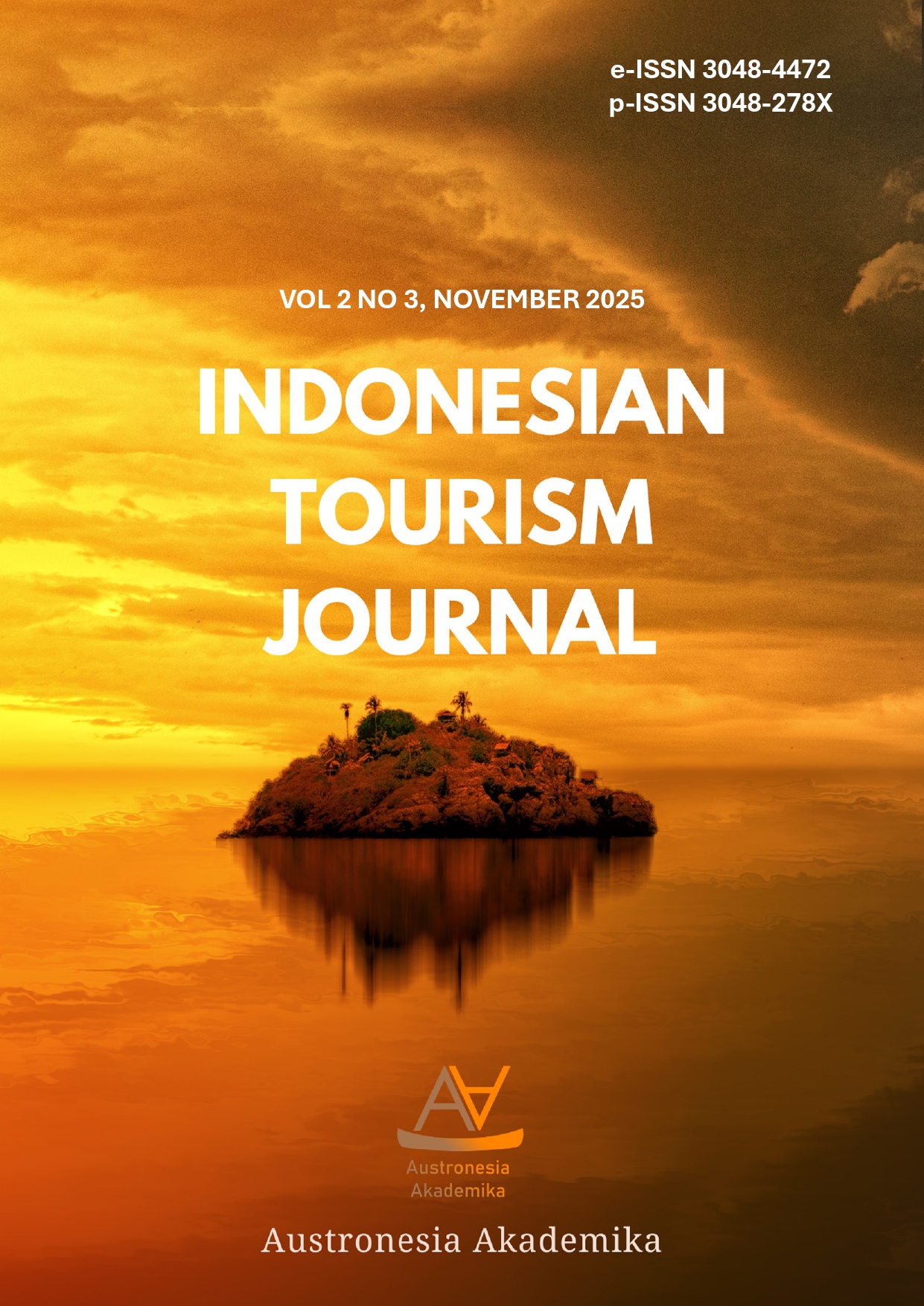
The Era of Modernization: Digital Technology Marketing Strategies in Tourist Attraction Development
DOI:
https://doi.org/10.69812/itj.v2i3.177Keywords:
Digital Technology, Digital Marketing, Ecotourism, Social MediaAbstract
The rapid advancement of digital technology has transformed how tourism destinations are promoted and managed, reshaping the competitiveness of ecotourism in the modern era. This study investigates digital technology–based marketing strategies for developing tourist attractions by integrating sustainability and community participation. The research aims to identify effective approaches for enhancing destination visibility and engagement through major social media platforms such as TikTok, Instagram, YouTube, and official tourism websites. Using a qualitative descriptive method, data were collected from literature reviews, online promotional content, and interviews with tourism stakeholders, including destination managers, digital marketing practitioners, and tourists. Analysis employed the Miles and Huberman model, encompassing data reduction, display, and conclusion drawing. The findings reveal that digital marketing significantly strengthens destination appeal through strategies tailored to each platform TikTok for virality, Instagram for branding, YouTube for in-depth storytelling, and websites for official information. Moreover, sustainable digitalization initiatives, including educational content, online booking systems, and collaborations with influencers and environmental NGOs, enhance conservation awareness and tourist experience. The study concludes that integrating digital marketing with sustainability principles fosters effective promotion and stakeholder synergy, while the government’s regulatory and facilitative roles are essential to ensuring alignment with eco-tourism values and long-term development goals.
Downloads
References
Abbasi, A. Z., Tsiotsou, R. H., Hussain, K., Rather, R. A., & Ting, D. H. (2023). Investigating the impact of social media images’ value, consumer engagement, and involvement on eWOM of a tourism destination: A transmittal mediation approach. Journal of Retailing and Consumer Services, 71, 103231. https://doi.org/10.1016/J.JRETCONSER.2022.103231
Agostino, D., Saliterer, I., & Steccolini, I. (2022). Digitalization, accounting and accountability: A literature review and reflections on future research in public services. Financial Accountability and Management, 38(2), 152–176. https://doi.org/10.1111/FAAM.12301
Armutcu, B., Tan, A., Amponsah, M., Parida, S., & Ramkissoon, H. (2023). Tourist behaviour: The role of digital marketing and social media. Acta Psychologica, 240, 104025. https://doi.org/10.1016/J.ACTPSY.2023.104025
Blanco-Moreno, S., González-Fernández, A. M., Muñoz-Gallego, P. A., & Casaló, L. V. (2024). Understanding engagement with Instagram posts about tourism destinations. Journal of Destination Marketing & Management, 34, 100948. https://doi.org/10.1016/J.JDMM.2024.100948
Bowen, G. A. (2009). Document analysis as a qualitative research method. Qualitative Research Journal, 9(2), 27–40. https://doi.org/10.3316/QRJ0902027/FULL/XML
Cao, X., Qu, Z., Liu, Y., & Hu, J. J. (2021). How the destination short video affects the customers’ attitude: The role of narrative transportation. Journal of Retailing and Consumer Services, 62, 102672. https://doi.org/10.1016/J.JRETCONSER.2021.102672
Dewi, K., Angligan, I. G. K. H., & Mahardika, I. M. N. O. (2023). Strategi Meningkatkan Peran Media Sosial Dalam Membranding Destinasi Wisata Sebagai Media Pemasaran. Waisya : Jurnal Ekonomi Hindu, 2(1), 1–11. https://doi.org/10.53977/JW.V2I1.923
Fauzi, D., & Sumirat, P. A. (2023). Evaluation of Indonesian Tourism Marketing towards Quality Tourism. International Journal of Magistravitae Management, 1(2), 117–129. https://doi.org/10.33019/ijomm.v1i2.22
Gan, J., Shi, S., Filieri, R., & Leung, W. K. S. (2023). Short video marketing and travel intentions: The interplay between visual perspective, visual content, and narration appeal. Tourism Management, 99, 104795. https://doi.org/10.1016/J.TOURMAN.2023.104795
Huerta-Álvarez, R., Cambra-Fierro, J. J., & Fuentes-Blasco, M. (2020a). The interplay between social media communication, brand equity and brand engagement in tourist destinations: An analysis in an emerging economy. Journal of Destination Marketing & Management, 16, 100413. https://doi.org/10.1016/J.JDMM.2020.100413
Huerta-Álvarez, R., Cambra-Fierro, J. J., & Fuentes-Blasco, M. (2020b). The interplay between social media communication, brand equity and brand engagement in tourist destinations: An analysis in an emerging economy. Journal of Destination Marketing & Management, 16, 100413. https://doi.org/10.1016/J.JDMM.2020.100413
Hussain, K., Didarul Alam, M. M., Malik, A., Tarhini, A., & Al Balushi, M. K. (2024). From likes to luggage: The role of social media content in attracting tourists. Heliyon, 10(19), e38914. https://doi.org/10.1016/J.HELIYON.2024.E38914
Lund, N. F., Cohen, S. A., & Scarles, C. (2018). The power of social media storytelling in destination branding. Journal of Destination Marketing & Management, 8, 271–280. https://doi.org/10.1016/J.JDMM.2017.05.003
Matheus, R., Janssen, M., & Janowski, T. (2021). Design principles for creating digital transparency in government. Government Information Quarterly, 38(1), 101550. https://doi.org/10.1016/J.GIQ.2020.101550
Miles, M. B., Huberman, A. M., & Saldana, J. (2014). Qualitative Data Analysis: A Methods Sourcebook. In Qualitative Data Analysis A Methods Sourcebook (3rd ed., Vol. 47, Issue Suppl 4). SAGE Publications. http://www.uk.sagepub.com/books/Book239534?siteId=sage-uk
Puspawati, D. P. H. (2018). Strategi Promosi Digital Untuk Pengembangan Pariwisata Kota Magelang. Jurnal Jendela Inovasi Daerah, 1(2), 1–20. https://doi.org/10.56354/JENDELAINOVASI.V1I2.14
Ramadhan, G., Wihardi, D., & Panca, G. (2024). Analisis Strategi Pemasaran Digital Dalam Ekowisata: Literature Review Dan Implikasinya Bagi Badan Otorita Borobudur. AGROMIX, 15(2), 129–138. https://doi.org/10.35891/AGX.V15I2.4491
Jalilvand, M. R., Samiei, N., Dini, B., & Yaghoubi Manzari, P. (2012). Examining the structural relationships of electronic word of mouth, destination image, tourist attitude toward destination and travel intention: An integrated approach. Journal of Destination Marketing & Management, 1(1–2), 134–143. https://doi.org/10.1016/J.JDMM.2012.10.001
Servaes, J., & Malikhao, P. (2016). Communication is essential for global impact. Procedia Engineering, 159, 316–321. https://doi.org/10.1016/j.proeng.2016.08.187
Shi, W., & Zhang, Z. (2025). Exploring the role of digital governance: The effect of audit digitalization on firms’ internal control weaknesses in China. International Journal of Accounting Information Systems, 56, 100756. https://doi.org/10.1016/J.ACCINF.2025.100756
Siswantoro, S., & Ikhwan, I. (2024). Building city branding of Yogyakarta as a cultural city: A youtube user-generated content analysis. Indonesian Tourism Journal, 1(1), 59–69. https://doi.org/10.69812/ITJ.V1I1.18
Sparks, B. A., & Browning, V. (2011). The impact of online reviews on hotel booking intentions and perception of trust. Tourism Management, 32(6), 1310–1323. https://doi.org/10.1016/J.TOURMAN.2010.12.011
Tang, X., Zhang, L., & Yuan, K. (2024). Social media frames my move and visual: The echo chamber effects on on-site tourism behaviors and destination marketing. Journal of Destination Marketing & Management, 32, 100859. https://doi.org/10.1016/J.JDMM.2024.100859
Wengel, Y., Ma, L., Ma, Y., Apollo, M., Maciuk, K., & Ashton, A. S. (2022a). The TikTok effect on destination development: Famous overnight, now what? Journal of Outdoor Recreation and Tourism, 37, 100458. https://doi.org/10.1016/J.JORT.2021.100458
Wengel, Y., Ma, L., Ma, Y., Apollo, M., Maciuk, K., & Ashton, A. S. (2022b). The TikTok effect on destination development: Famous overnight, now what? Journal of Outdoor Recreation and Tourism, 37, 100458. https://doi.org/10.1016/J.JORT.2021.100458
Yoo, J. J., Kim, H., & Choi, S. (2024). Expanding knowledge on emotional dynamics and viewer engagement: The role of travel influencers on youtube. Journal of Innovation & Knowledge, 9(4), 100616. https://doi.org/10.1016/J.JIK.2024.100616
Zhou, Q., Sotiriadis, M., & Shen, S. (2023). Using TikTok in tourism destination choice: A young Chinese tourists’ perspective. Tourism Management Perspectives, 46, 101101. https://doi.org/10.1016/J.TMP.2023.101101
Downloads
Published
Issue
Section
License
Copyright (c) 2025 Nerisma Eka Putri, Muhammad Azkia Fahmi, Randu Rahmatan Hanif, Khaidir Ali Junid

This work is licensed under a Creative Commons Attribution-ShareAlike 4.0 International License.
You are free to:
- Share — copy and redistribute the material in any medium or format for any purpose, even commercially.
- Adapt — remix, transform, and build upon the material for any purpose, even commercially.
- The licensor cannot revoke these freedoms as long as you follow the license terms.
Under the following terms:
- Attribution — You must give appropriate credit, provide a link to the license, and indicate if changes were made . You may do so in any reasonable manner, but not in any way that suggests the licensor endorses you or your use.
- ShareAlike — If you remix, transform, or build upon the material, you must distribute your contributions under the same license as the original.
- No additional restrictions — You may not apply legal terms or technological measures that legally restrict others from doing anything the license permits.