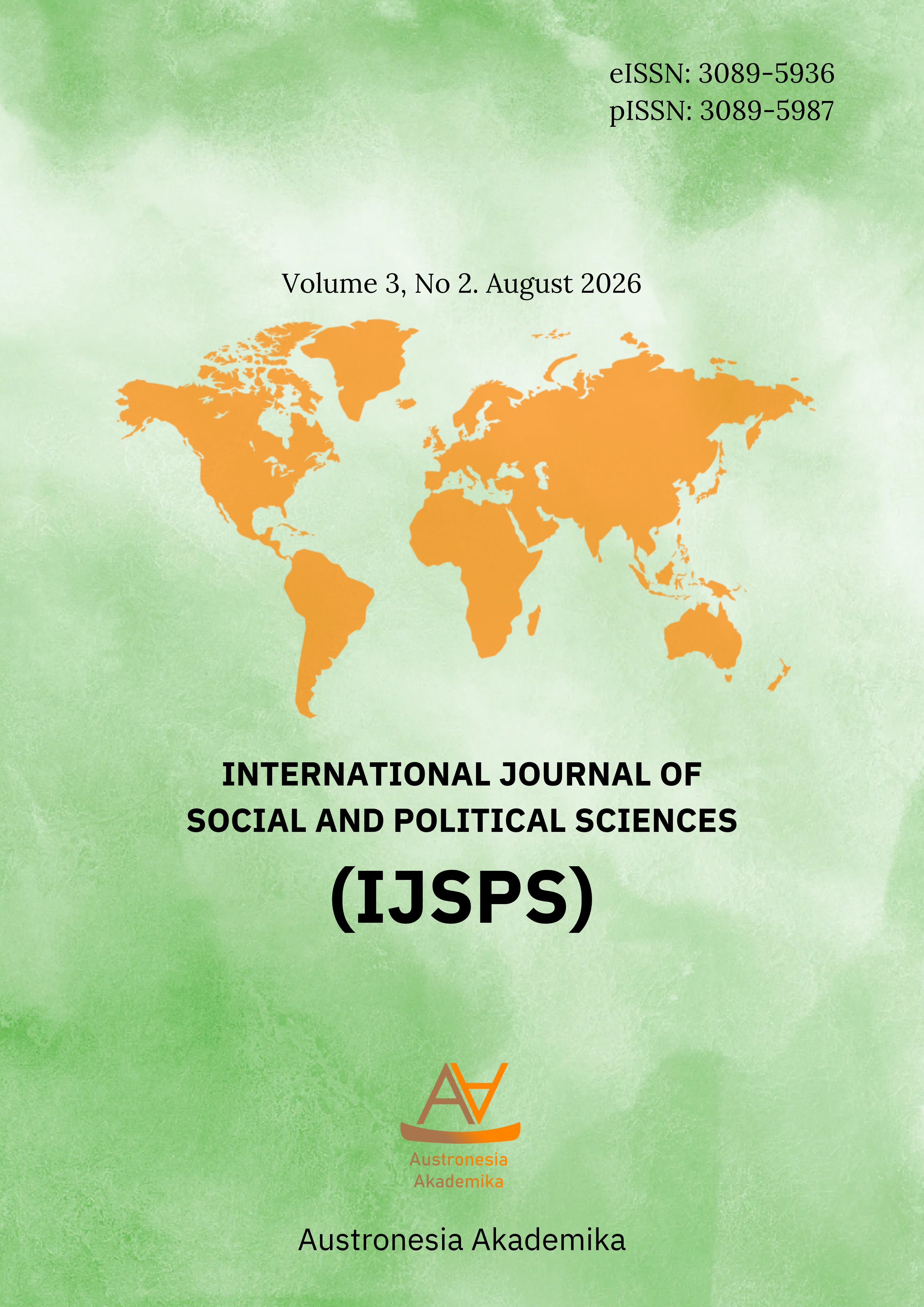
From Hashtags to Streets: Youth Political Mobilization and Democratic Accountability in Indonesia
DOI:
https://doi.org/10.69812/ijsps.v3i2.241Keywords:
Digital Activism, Youth Mobilization, Democratic, PoliticAbstract
Indonesia's digitally connected public sphere has become a consequential arena for youth mobilization, yet the democratic value of online dissent cannot be inferred from hashtag visibility alone. This study examines how digital expression, collective action, and demands for institutional accountability interacted across electoral controversy in 2024, the #IndonesiaGelap protests of February 2025, and public demonstrations in August 2025. Using a comparative documentary design, the analysis integrates independently published scholarship, official electoral statistics, internet penetration surveys, fact-checking records, and contemporaneous reporting available through November 2026. Evidence is evaluated through source triangulation and a mechanism-oriented comparison rather than unsupported causal estimation. Indonesia's internet penetration increased from 79.50 percent in 2024 to 81.72 percent in 2026, while the 2024 voter register included 46.8 million Generation Z citizens and 66.8 million millennials. These structural conditions facilitated political visibility but did not guarantee equal participation, factual reliability, or policy responsiveness. The case comparison identifies five linked mechanisms: grievance framing, distributed amplification, identity-based coordination, offline conversion, and public accountability feedback. Disinformation, algorithmic selectivity, unequal connectivity, and episodic institutional response interrupted those pathways. The study proposes a conditional digital-to-democratic accountability framework in which meaningful impact depends on verifiable information, organizational bridging, protected civic space, and traceable governmental follow-through. The findings offer a transparent secondary-data account of contemporary Indonesian mobilization without representing documentary observations as original interview or survey results.
Downloads
References
Allcott, H., & Gentzkow, M. (2017). Social media and fake news in the 2016 election. Journal of Economic Perspectives, 31(2), 211–236. https://doi.org/10.1257/jep.31.2.211
Amsalem, E., & Nir, L. (2021). Does interpersonal discussion increase political knowledge? A meta-analysis. Communication Research, 48(5), 619–641.
Amsalem, E., & Zoizner, A. (2023). Do people learn about politics on social media? A meta-analysis of 76 studies. Journal of Communication, 73(1), 3–13.
Arofah, K., & Triwardani, R. (2025). #IndonesiaGelap: Examining digital protests of Indonesian politics in social media. Asian Politics & Policy, 17, e70035. https://doi.org/10.1111/aspp.70035
Bakir, V., & McStay, A. (2018). Fake news and the economy of emotions. Digital Journalism, 6(2), 154–175. https://doi.org/10.1080/21670811.2017.1345645
Benaissa Pedriza, S. (2021). Sources, channels and strategies of disinformation in the 2020 US election: Social networks, traditional media and political candidates. Journalism and Media, 2(4), 605–624. https://doi.org/10.3390/journalmedia2040036
Boulianne, S. (2020). Twenty years of digital media effects on civic and political participation. Communication Research, 47(7), 947–966.
Boulianne, S., Oser, J., & Hoffmann, C. P. (2023). Powerless in the digital age? A systematic review and meta-analysis of political efficacy and digital media use. New Media & Society, 25(9). https://doi.org/10.1177/14614448231176519
Boulianne, S., Koc-Michalska, K., & Bimber, B. (2020). Right-wing populism, social media and echo chambers in Western democracies. New Media & Society, 22(4), 683–699.
Cano-Orón, L., Calvo, D., López-García, G., & Baviera, T. (2021). Disinformation in Facebook ads in the 2019 Spanish general election campaigns. Media and Communication, 9(1), 217–228. https://doi.org/10.17645/mac.v9i1.3335
Carral, U., Tuñón, J., & Elías, C. (2023). Populism, cyberdemocracy and disinformation: Analysis of the social media strategies of the French extreme right in the 2014 and 2019 European elections. Humanities and Social Sciences Communications, 10. https://doi.org/10.1057/s41599-023-01507-2
Dan, V., Paris, B., Donovan, J., Hameleers, M., Roozenbeek, J., van der Linden, S., & von Sikorski, C. (2021). Visual mis- and disinformation, social media, and democracy. Journalism & Mass Communication Quarterly, 98(3), 641–664. https://doi.org/10.1177/10776990211035395
Dewi, E. A. S., Sanofi, Z., Wibowo, K. A., & Arifin, H. S. (2025). Political communication preferences of Generation Z in West Java: Insights from an explanatory sequential study. International Journal of Adolescence and Youth, 30(1), 2512841. https://doi.org/10.1080/02673843.2025.2512841
Dommett, K., & Power, S. (2019). The political economy of Facebook advertising: Election spending, regulation and targeting online. Political Quarterly, 90(2), 257–265. https://doi.org/10.1111/1467-923X.12687
Facciani, M., Idris, I. K., & Weninger, T. (2023). Comparison of news literacy, media consumption, and trust between Indonesia and Malaysia. Asian Journal of Media and Communication, 7(2), 83–100. https://doi.org/10.20885/asjmc.vol7.iss2.art2
Ferrara, E., Chang, H., Chen, E., Muric, G., & Patel, J. (2020). Characterizing social media manipulation in the 2020 US presidential election. First Monday, 25(11). https://doi.org/10.5210/fm.v25i11.11431
Gray, J., Bounegru, L., & Venturini, T. (2020). “Fake news” as infrastructural uncanny. New Media & Society, 22(2), 317–341. https://doi.org/10.1177/1461444819856912
Hannan, J. (2018). Trolling ourselves to death? Social media and post-truth politics. European Journal of Communication, 33(2), 214–226. https://doi.org/10.1177/0267323118760323
Hansen, I., & Lim, D. J. (2019). Doxing democracy: Influencing elections via cyber voter interference. Contemporary Politics, 25(2), 150–171. https://doi.org/10.1080/13569775.2018.1493629
Kim, Y. M., Hsu, J., Neiman, D., Kou, C., Bankston, L., Kim, S. Y., Heinrich, R., Baragwanath, R., & Raskutti, G. (2018). The stealth media? Groups and targets behind divisive issue campaigns on Facebook. Political Communication, 35(4), 515–541. https://doi.org/10.1080/10584609.2018.1476425
Kreiss, D., & McGregor, S. C. (2018). Technology firms shape political communication: The work of Microsoft, Facebook, Twitter, and Google with campaigns during the 2016 U.S. presidential cycle. Political Communication, 35(2), 155–177. https://doi.org/10.1080/10584609.2017.1364814
Lukito, J. (2020). Coordinating a multi-platform disinformation campaign: Internet Research Agency activity on three U.S. social media platforms, 2015 to 2017. Political Communication, 37(2), 238–255. https://doi.org/10.1080/10584609.2019.1661889
Mauk, M., & Grömping, M. (2024). Online disinformation predicts inaccurate beliefs about election fairness among both winners and losers. Comparative Political Studies, 57, 965–998. https://doi.org/10.1177/00104140231193008
Mohamed, A. A., Masuwd, M., Mahmudulhassan, M., & Yunusa, U. A. (2026). The political economy of digital inequality and education; rights in Kenya and Indonesia. International Journal of Social and Political Sciences, 3(1), 17–31. https://doi.org/10.69812/ijsps.v3i1.235
Oser, J., & Boulianne, S. (2020). Reinforcement effects between digital media use and political participation: A meta-analysis of repeated-wave panel data. Public Opinion Quarterly, 84(S1), 355–365. https://doi.org/10.1093/poq/nfaa017
Oser, J., Grinson, A., Boulianne, S., & Halperin, E. (2022). How political efficacy relates to online and offline political participation: A multilevel meta-analysis. Political Communication, 39(5), 607–633. https://doi.org/10.1080/10584609.2022.2086329
Pérez-Curiel, C., & Rivas-de-Roca, R. (2022). Exploring populism in times of crisis: An analysis of disinformation in the European context during the US elections. Journalism and Media, 3(1), 144–156. https://doi.org/10.3390/journalmedia3010012
Roozenbeek, J., & van der Linden, S. (2019). Fake news game confers psychological resistance against online misinformation. Palgrave Communications, 5, 65. https://doi.org/10.1057/s41599-019-0279-9
Rossini, P., Stromer-Galley, J., & Korsunska, A. (2021). More than “fake news”? The media as a malicious gatekeeper and a bully in the discourse of candidates in the 2020 US presidential election. Journal of Language and Politics, 20(5), 676–695. https://doi.org/10.1075/jlp.21033.ros
Shin, J., Jian, L., Driscoll, K., & Bar, F. (2017). Political rumoring on Twitter during the 2012 US presidential election: Rumor diffusion and correction. New Media & Society, 19(8), 1214–1235. https://doi.org/10.1177/1461444816634054
Subekti, D., Nurmandi, A., & Mutiarin, D. (2022). Mapping publication trend of political parties campaign in social media: A bibliometric analysis. Journal of Political Marketing. https://doi.org/10.1080/15377857.2022.2104424
Subekti, D., Yusuf, M., Saadah, M., & Wahid, M. (2025). Social media and disinformation for candidates: The evidence in the 2024 Indonesian presidential election. Frontiers in Political Science, 7, 1625535. https://doi.org/10.3389/fpos.2025.1625535
Downloads
Published
Issue
Section
License
Copyright (c) 2026 Naureen Savaira Sherazade Darmawan, Yudithia Yudithia

This work is licensed under a Creative Commons Attribution-ShareAlike 4.0 International License.
You are free to:
- Share — copy and redistribute the material in any medium or format for any purpose, even commercially.
- Adapt — remix, transform, and build upon the material for any purpose, even commercially.
- The licensor cannot revoke these freedoms as long as you follow the license terms.
Under the following terms:
- Attribution — You must give appropriate credit, provide a link to the license, and indicate if changes were made . You may do so in any reasonable manner, but not in any way that suggests the licensor endorses you or your use.
- ShareAlike — If you remix, transform, or build upon the material, you must distribute your contributions under the same license as the original.
- No additional restrictions — You may not apply legal terms or technological measures that legally restrict others from doing anything the license permits.